

Buying a home while keeping your current property as a rental? Planning to purchase an investment property? Or hoping to use rental income to help you qualify for a mortgage?
If any of these plans sound familiar, there are important Fannie Mae guideline updates you should understand before moving forward.
Fannie Mae has updated its rental income guidelines, affecting how lenders evaluate income from departing residences, short-term rentals, and recently purchased investment properties. These updates may change how much rental income you can use to qualify for a mortgage.
We worked with Derek Beisner of Summit Mortgage Corporation, an experienced mortgage professional, to help explain what these changes mean for buyers in straightforward terms.
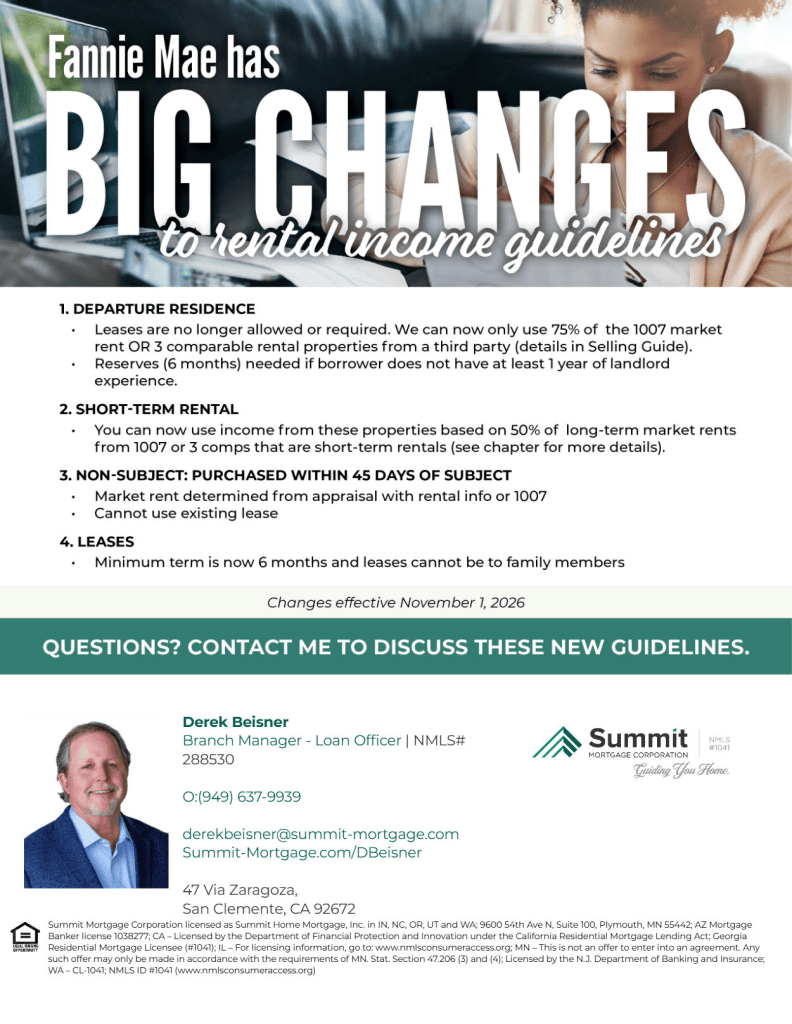
Here is what you need to know and how to prepare.
1. Turning Your Current Home Into a Rental? Here’s What Changes.
Imagine you own a home and want to purchase another one. Instead of selling your current home, you plan to move out and rent it to tenants.
This is known as a departing residence.
Under the updated guidelines, lenders can no longer rely on a lease agreement alone to determine the qualifying rental income from that departing residence. Instead, they must establish the property’s market rent using an appraisal that includes rental information, a Form 1007 rental analysis, or other permitted market-rent documentation supported by comparable rental properties.
What does this mean for you?

Let’s say you expect to rent your current home for $4,000 per month. You may not automatically qualify using the full $4,000 as rental income.
For qualifying purposes, the lender generally calculates 75% of the supported monthly market rent before subtracting the property’s monthly mortgage-related expenses, including principal, interest, taxes, insurance, and applicable association dues.
Using our example:
- Estimated market rent: $4,000 per month
- Rental income after the 25% adjustment: $3,000 per month
- The lender then accounts for the property’s monthly housing expenses to determine how the rental income affects your qualification.
There is another important consideration: if you have less than 12 months of property management experience, you generally need six months of reserves to cover the departing property’s housing expenses. These reserves are in addition to any other applicable reserve requirements.
The takeaway: If you plan to keep your current home and rent it out, talk with your lender before assuming the rental income will make qualifying for your next home easier.
2. Planning to Use Short-Term Rental Income? Know the New Calculation.
Short-term rentals, including eligible vacation rental properties, can be part of an investment strategy. However, the income you earn from nightly or weekly bookings may not be counted the same way you expect.
Under the updated guidelines, lenders can use eligible short-term rental income for qualifying purposes based on permitted rental-market documentation. This may include a Form 1007 using standard long-term market rents or validated data for comparable short-term rentals from approved third-party sources.

For a purchase, the lender generally uses 50% of the supported monthly gross rental amount to account for vacancy, maintenance, and other operating costs. The lender then subtracts the property’s monthly housing expenses to determine the qualifying impact.
For example, if the supported monthly gross rental amount is $3,000:
- Supported monthly gross rental income: $3,000
- Amount remaining after the 50% adjustment: $1,500
- The lender then accounts for the property’s monthly housing expenses.
The final calculation determines whether the rental income can help offset the property’s housing expenses or whether a rental loss must be considered in your overall debt-to-income ratio.
There are also eligibility requirements. For example, these short-term rental provisions generally apply to eligible one-unit investment properties that are legally permitted to operate as short-term rentals. Accessory dwelling units (ADUs) cannot generate qualifying income under this particular short-term rental provision.
The takeaway: If you are counting on Airbnb or other short-term rental income to help you qualify, ask your lender how the updated calculation applies to your specific property.
3. Buying an Investment Property Shortly Before Your New Home?
Timing matters when you purchase an investment property close to the time you apply for a mortgage on another home.
Under the updated guidelines for investment properties purchased within 45 days of the subject property’s application date, lenders cannot use an existing lease agreement to determine the property’s qualifying rental income.
Instead, the lender must establish market rent through permitted documentation, such as an appraisal with rental information, a Form 1007 for an eligible single-unit property, or other acceptable market analysis supported by comparable rentals.
Generally, the lender uses 75% of the supported monthly gross rental amount and then subtracts the property’s monthly housing expenses to calculate the qualifying impact.
This means that even if you already have a tenant or expect a certain rental amount, the lender may need to use a different method to calculate the income that can count toward your mortgage qualification.
The takeaway: If you’re buying an investment property and a primary residence around the same time, discuss the timing and financing of both purchases with your lender before making commitments.
4. Lease Agreements Have Additional Requirements.
Lease agreements remain an important part of rental property financing, but they do not automatically establish qualifying rental income in every situation.
Under the updated general guidelines, newly executed leases used for qualifying purposes on properties not reported on your most recent individual federal income tax return generally must have a minimum term of six months.
The applicable rules also restrict leases with family members or other interested parties in certain circumstances. Lenders may need documentation showing that a lease has taken effect, such as evidence of rent payments, a security deposit, or other permitted documentation.
These requirements can matter if you’re relying on a newly rented property to support your mortgage application.
The takeaway: Before signing a lease or making plans around projected rental income, have your lender review the arrangement and confirm what documentation will be acceptable.
When Do the Updated Guidelines Take Effect?
Fannie Mae published these rental income updates on September 2, 2026. Its published implementation guidance allows lenders to apply the updates immediately, but requires implementation no later than December 1, 2026.
The flyer accompanying this article identifies November 1, 2026, as the effective date. Because lenders may implement the updates at different times within Fannie Mae’s implementation window, confirm the applicable date and requirements with your mortgage professional.
The important point is to understand which guidelines will apply to your loan before you finalize your buying plans.
What Should Buyers Do Now?
You do not necessarily need to abandon your plans to buy a home, keep an existing property as a rental, or invest in real estate. However, you should understand how a lender will calculate your income and obligations before making financial decisions.
Here are four practical steps to take:
- Talk to a knowledgeable lender early. Review your income, existing mortgage payments, rental properties, and upcoming purchase plans.
- Gather your rental documentation. This may include tax returns, lease agreements, comparable rental information, and records of rental income.
- Review your available reserves. Keeping a property as a rental may require additional funds to cover its housing expenses.
- Revisit your qualification before making an offer. A change in how rental income is calculated can affect your debt-to-income ratio and the loan amount you may qualify for.
Every buyer’s situation is different. Your eligibility will depend on the complete loan application, applicable underwriting requirements, and the lender’s review.
Let’s See How These Changes Affect Your Homebuying Plans
Whether you’re purchasing your first home, moving into a new primary residence while keeping your current home, or exploring an investment property, understanding your financing options can help you make more informed decisions.
We’re grateful to Derek Beisner, Branch Manager and Loan Officer at Summit Mortgage Corporation, for helping us explain these important updates and their potential impact on buyers.
Derek and I would be happy to help you understand your next steps.
Not sure whether you’ll still qualify under the updated Fannie Mae rental income guidelines? Let’s find out before you make your next move.
Contact me through AskAngie.com or reach out to Derek directly to discuss your situation.
Derek Beisner | Summit Mortgage Corporation
Phone: (949) 637-9939
Email: derekbeisner@summit-mortgage.com
Website: Summit-Mortgage.com/DBeisner
Mortgage qualification is subject to lender review, applicable underwriting guidelines, and approval. This article is for educational purposes only and is not a guarantee of loan approval.
Let’s Talk About Your Homebuying Plans
Have questions about how the updated rental income guidelines could affect your mortgage qualification? Fill out the form below, and we’ll help you connect with the right person to review your situation.









Leave a Reply