
Your year-end 1031 exchange is about more than deferring capital gains taxes. It’s about protecting your investment equity, coordinating multiple transactions, and entering the new year with a clear financial picture.
If you’re planning to exchange an Orange County investment property before December 31, you already understand the potential tax advantages.
But knowing how a 1031 exchange works and successfully executing one are two very different things.
The challenge isn’t simply selling your property. It’s securing the right replacement investment, coordinating escrow and financing, protecting your exchange proceeds, and making sure the entire transaction aligns with your tax strategy.
And when the calendar is running out? Every detail matters.
A clean year-end closing starts with a coordinated plan, not a last-minute scramble.
If you’re newer to the process, I’ve covered the fundamentals in my earlier article, Orange County 1031 Exchange & Other Investor Property Tax Shelters. This article focuses on what you need to know when you’re ready to execute your next exchange.
Why Does a Clean Year-End Closing Matter for Your 1031 Exchange?
Closing your relinquished property before December 31 establishes the disposition in the current tax year and gives you a specific transaction date for tax reporting and exchange planning.
As an experienced investor, you know how valuable it is to have your real estate transactions organized before sitting down with your CPA.
You want accurate closing statements, clear ownership records, completed exchange documentation, and a plan for how the transaction affects your investment portfolio.
What you don’t want is a rushed closing that leaves unresolved questions about proceeds, financing, expenses, or the timing of your next acquisition.
There’s also an important distinction between closing your relinquished property and completing the entire exchange.
You do not have to finish a 1031 exchange by December 31 to qualify for tax deferral. However, the year in which your relinquished property transfers determines the tax year associated with the transaction and starts the exchange deadlines.
If your exchange extends into the next year, your CPA must also consider the tax return filing deadline and whether an extension is necessary.
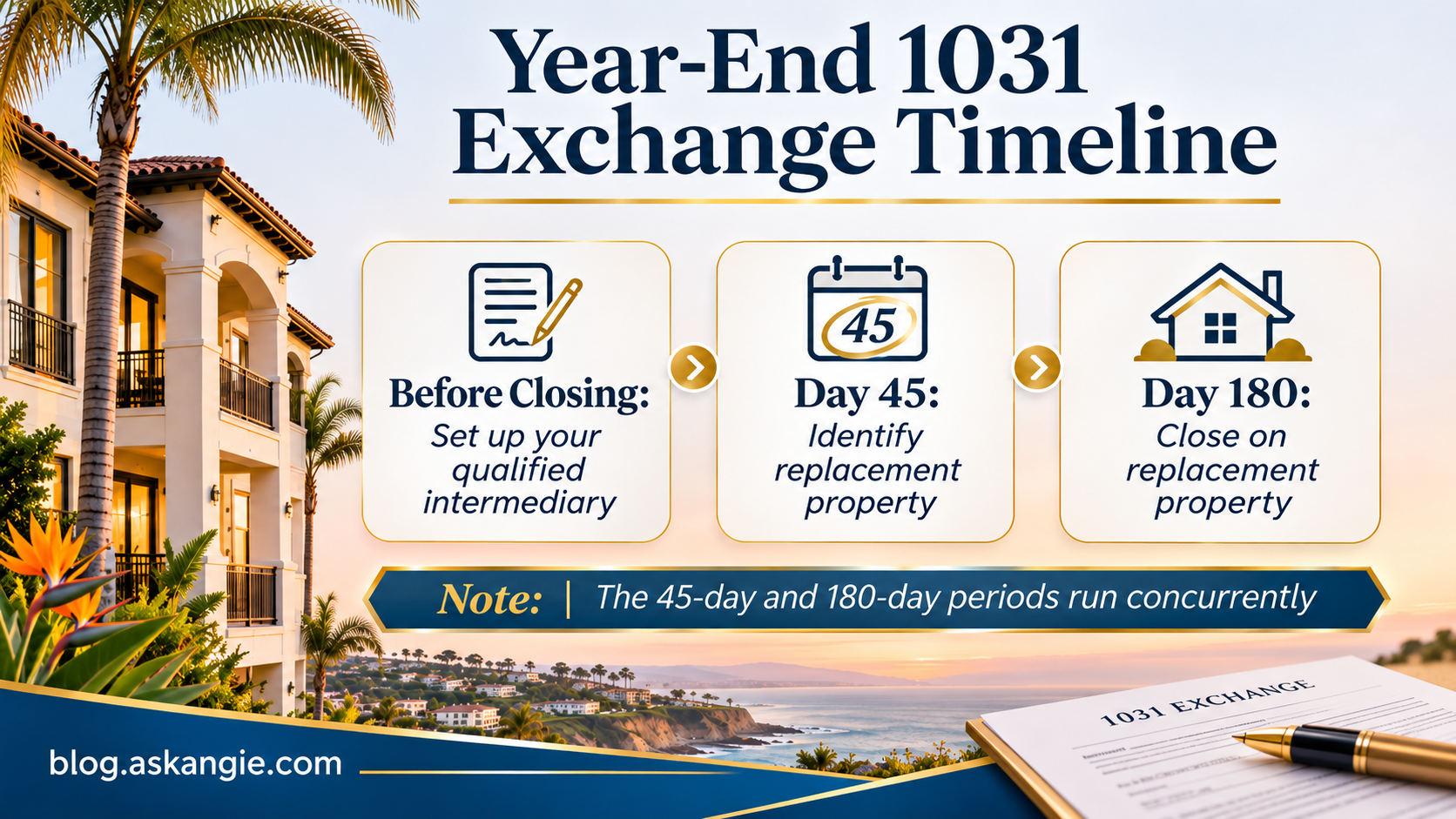
The IRS requires replacement property to be identified within 45 days and acquired by the earlier of 180 days after the relinquished property transfers or the tax return due date, including extensions. These deadlines run concurrently.
Source: IRS Instructions for Form 8824
The real benefit of year-end planning is control. You want to know exactly where your transaction stands, what your next obligations are, and what documentation your tax team needs.
That kind of clarity can make tax season significantly easier.
How Can You Avoid Losing Valuable Investment Opportunities During Your 1031 Exchange?
Your replacement-property strategy needs to be in motion before your relinquished property closes.
You may have significant equity in an Orange County rental property, but your next challenge is finding a replacement investment that meets your financial objectives and exchange requirements.
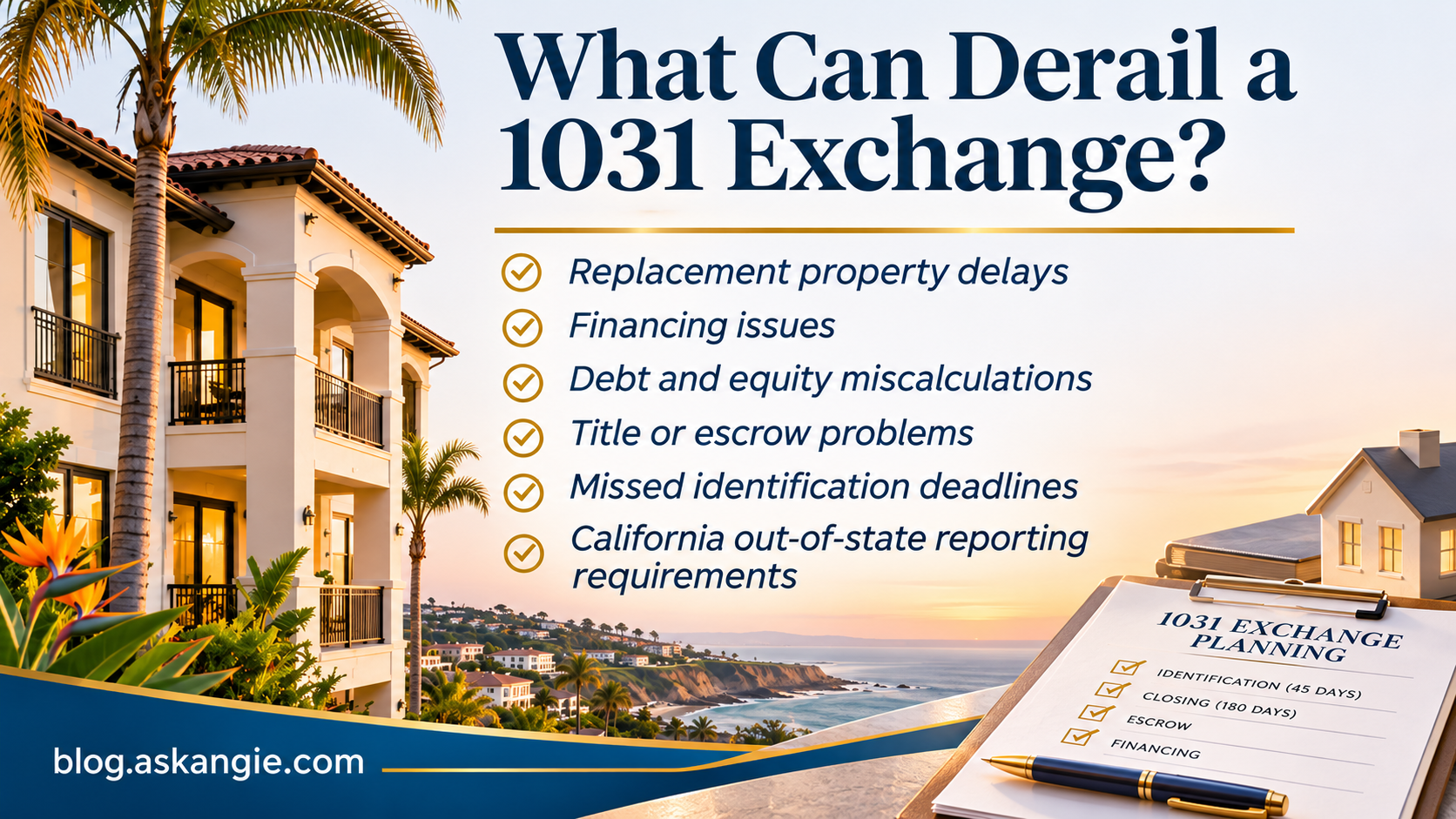
What happens when the property you want has title issues? Or the seller refuses to cooperate with your closing schedule? Or your lender discovers a problem late in underwriting?
These are the situations that can put your exchange at risk.
Your 45-day identification deadline is fixed by federal law, subject only to specific exceptions such as qualifying disaster relief. It does not restart because a seller backs out or your first-choice property doesn’t work.
That’s why you need more than one promising option.
Your investment team should help you:
- Evaluate viable replacement properties before your relinquished property closes.
- Understand the applicable identification rules, including the three-property rule and 200% rule.
- Identify backup properties that meet your investment criteria.
- Review financing and property condition concerns early.
- Coordinate acquisition timelines with your exchange intermediary.
- Keep your purchase strategy focused on investment performance, not simply meeting a deadline.
The goal is to enter your identification period prepared, rather than trying to build an investment strategy while the clock is ticking.
You shouldn’t have to compromise your long-term investment goals just because your exchange deadline is approaching.
Are Financing, Debt Replacement, and Equity Requirements Putting Your Exchange at Risk?
Your next property’s purchase price, financing structure, and use of exchange proceeds can directly affect how much gain you successfully defer.
One of the most frustrating situations you can face is identifying a desirable replacement property, only to discover that the financing doesn’t support your exchange objectives.
You may be trying to acquire a property with a larger loan, reduce your debt exposure, or reinvest proceeds across multiple properties.
Each decision has tax and financing implications.
If your goal is full tax deferral, your CPA and qualified intermediary need to review the replacement property’s value, the debt being paid off, your planned financing, and the cash you’ll contribute.
Simply purchasing another property isn’t enough to guarantee full deferral.
Receiving cash or non-like-kind property, or experiencing certain forms of debt relief without offsetting consideration, can result in taxable gain.
This is where working with an experienced investment lending professional can make a significant difference.
You’ll want your lender to understand your acquisition timeline, the type of replacement property you’re purchasing, and how financing contingencies could affect closing.
If you’re planning to use rental income when qualifying for financing, you may also find my article on Fannie Mae’s updated rental income guidelines helpful. Your lender should confirm which guidelines apply to your transaction.
The last thing you want is to discover a financing problem after your exchange proceeds are already committed.
What Happens When Your Replacement Property Closing Gets Delayed?
A delayed replacement-property closing can jeopardize your exchange if you cannot acquire qualifying property within the required exchange period.
Perhaps your replacement property has unresolved permit concerns. Maybe the lender requests additional documentation. Or the seller needs an unexpected extension.
Any one of those problems can create complications, especially when you’re approaching your 180-day deadline.
Unlike a typical real estate transaction, you cannot assume that extending escrow automatically extends your 1031 exchange deadline.
If your closing slips beyond the applicable IRS deadline without qualifying relief, your exchange can fail.
And that could mean recognizing taxable gain you had planned to defer.
This is why transaction coordination matters so much.
Your real estate team should monitor escrow milestones, financing approvals, title matters, inspections, seller obligations, and closing requirements throughout the transaction.
You need the right people communicating before problems become emergencies.
The difference between a stressful exchange and an organized one often comes down to how early your team identifies and addresses potential obstacles.
For more about why coordination is essential when multiple closings overlap, read my article on simplifying a contingent sale. Although a contingent home sale isn’t a 1031 exchange, both transactions demonstrate the importance of organized timelines and clear communication.
How Can You Keep More Investment Capital Working Through a 1031 Exchange?
Deferring eligible capital gains taxes allows you to preserve more of your investment equity for the next real estate acquisition instead of paying those taxes immediately.
You already know the basic tax benefit. The bigger question is what that preserved capital can accomplish.
Could it help you acquire an investment property with stronger rental income?
Could you reposition your portfolio into a property with fewer management responsibilities?
Could you diversify into multiple investments rather than continuing to hold one property?
Or perhaps you’re ready to transition out of an older rental that requires constant repairs and into something better suited to your long-term goals.
A successful exchange gives you the opportunity to make those decisions using more of your available equity.
However, tax deferral alone shouldn’t determine which property you purchase.
Your next investment still needs to make sense when you evaluate its acquisition price, operating expenses, insurance, financing, anticipated rental income, and future maintenance requirements.
The smartest exchange isn’t necessarily the one involving the most expensive replacement property. It’s the one that supports your long-term investment strategy while meeting your tax objectives.
For an additional Orange County market perspective, review my 2027 Orange County housing market forecast as you consider where your next investment may fit.
Are You Overlooking California’s Tax Requirements When Exchanging Into Another State?
Exchanging an Orange County investment property for qualifying real estate outside California does not automatically eliminate California’s claim to deferred California-source gains.
If you’re considering purchasing replacement property in Arizona, Nevada, Texas, or another state, this deserves attention before you close.
California requires Form FTB 3840 when California property is exchanged for out-of-state property and qualifying California-source gain or loss remains deferred.
The form must be filed for the exchange year and subsequent required years, typically until the deferred gain or loss is recognized.
This creates an ongoing reporting responsibility that needs to remain on your accountant’s radar.
Your replacement property may be located outside California, but the state can retain the right to tax the original California-source gain when it becomes recognizable.
If you’re managing several exchanges or properties in multiple states, accurate records become even more important.
According to the California Franchise Tax Board.
Before choosing an out-of-state replacement, make sure your CPA has evaluated your California reporting obligations and understands your long-term plans for the property.
Why Is Having the Right 1031 Exchange Team So Important Before Year-End?
Your 1031 exchange is only as organized as the professionals coordinating it.
You’re managing a significant financial transaction with multiple moving parts. You shouldn’t have to personally chase every document, verify every closing milestone, or discover late in escrow that two professionals were working from different timelines.
Your exchange requires people who understand their responsibilities and communicate with one another.
A coordinated team includes:
Your real estate professional: Helps position your relinquished property for sale, identify replacement investments, negotiate terms, and coordinate the transaction.
Your qualified intermediary: Establishes the exchange structure, handles exchange funds under the applicable agreements, and coordinates the identification and exchange documentation.
Your CPA or tax adviser: Evaluates the tax implications, adjusted basis, gain deferral, financing considerations, and federal and California reporting requirements.
Your investment lender: Reviews financing qualifications, debt structure, underwriting requirements, and funding timelines.
Your escrow and title professionals: Coordinate title review, settlement documentation, recording, and closing requirements.
When these professionals work together from the beginning, you’re better positioned to identify problems before they threaten the transaction.
For a year-end closing, that teamwork can be particularly valuable.
Maybe you’re traveling for the holidays. Maybe your accountant is busy preparing for tax season. Or perhaps you’re coordinating multiple property transactions while running a business or managing other investments.
Your real estate transaction shouldn’t become another full-time job.
My goal is to help you make informed property decisions and bring the appropriate professionals into the process early, so you can focus on your larger investment objectives.
What Should Be on Your 1031 Exchange Year-End Closing Checklist?
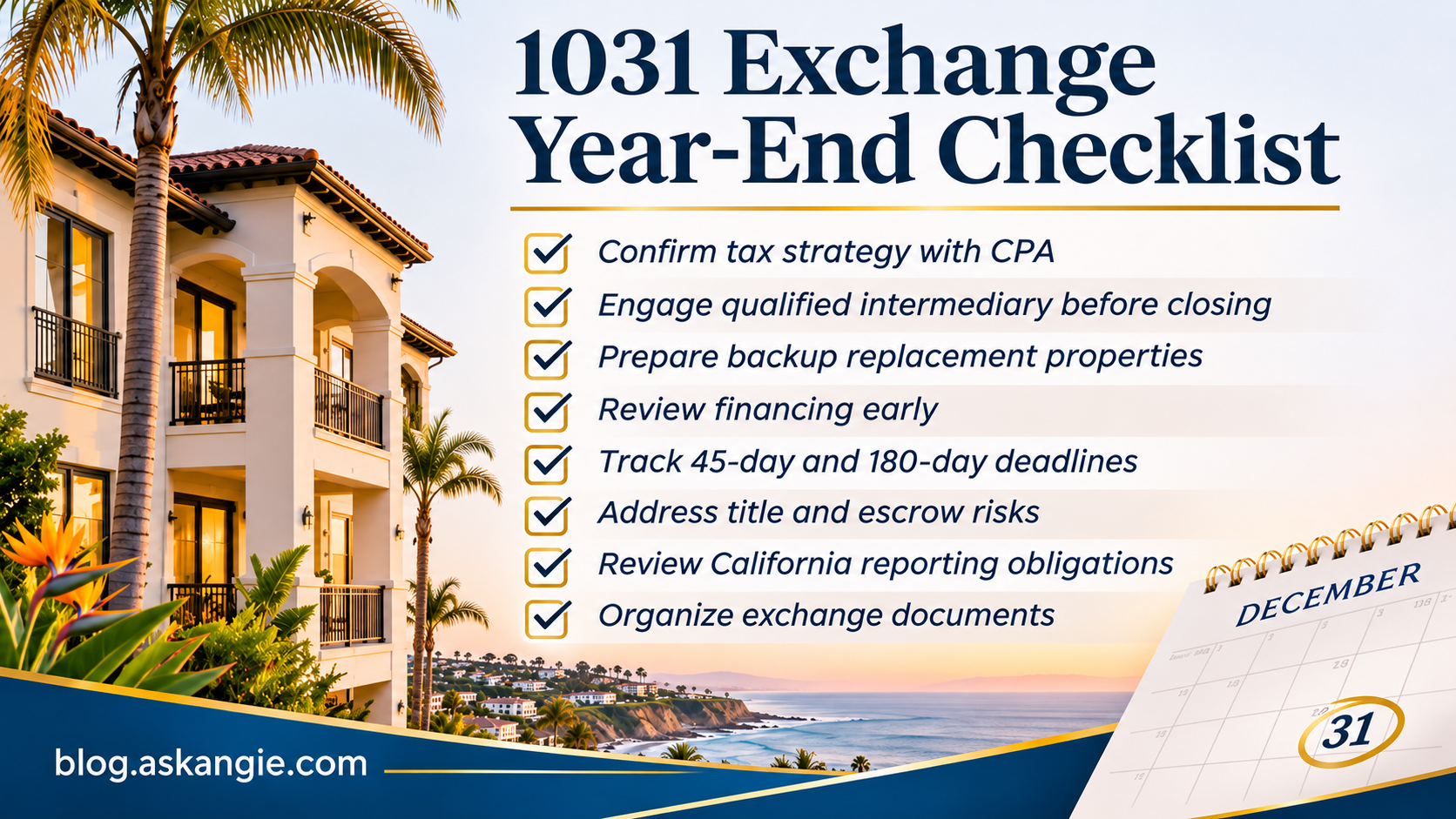
Before committing to a year-end exchange, you want a coordinated plan covering your tax objectives, replacement properties, financing, transaction deadlines, and reporting documents.
Use this checklist with your professional team:
- Confirm your tax objectives. Have your CPA calculate your expected gain, adjusted basis, depreciation implications, and intended deferral.
- Establish the exchange before closing. Confirm that your qualified intermediary and exchange documents are in place before transferring the relinquished property.
- Verify your deadlines. Record the actual 45-day identification date, 180-day completion date, and potentially earlier tax return deadline.
- Prepare your replacement-property options. Assess your preferred acquisitions and available backups against the IRS identification rules.
- Review your financing. Confirm underwriting readiness, loan requirements, debt considerations, and expected funding dates.
- Monitor closing risks. Address title, inspection, insurance, tenancy, HOA, and seller-related issues early.
- Confirm state reporting. If you’re exchanging out of California, discuss Form FTB 3840 with your tax team.
- Organize your documentation. Make sure your CPA receives exchange agreements, closing statements, property identification records, financing details, and other relevant tax records.
You don’t have to personally manage every detail, but you do need a team that understands how those details fit together.
Ready to Execute Your Next Orange County 1031 Exchange Before Year-End?
If you’re an experienced real estate investor, you already understand why a 1031 exchange can be valuable.
Now it’s about execution.
You want to protect your equity, find the right replacement investment, coordinate your professionals, and avoid unnecessary complications as the year comes to a close.
Whether you’re exchanging a rental property in Irvine, repositioning a multifamily investment in Anaheim, or exploring opportunities beyond Orange County, having a plan in place early can make the process far easier.
Contact me to discuss your next investment property.
Let’s review your real estate goals, explore replacement property opportunities, and help coordinate the right team so your next 1031 exchange is organized, efficient, and aligned with your year-end plans.
Frequently Asked Questions for Experienced 1031 Exchange Investors
Can I close my relinquished property in December and complete the exchange next year?
Yes. Your exchange can cross calendar years as long as you comply with the applicable identification and completion deadlines. The replacement property must be identified within 45 days after the relinquished property transfers and received by the earlier of 180 days or the relevant tax return due date, including extensions. Coordinate with your CPA to determine whether a filing extension is necessary to preserve the full exchange period.
Can I change replacement properties after the 45-day identification period?
You cannot add or substitute new replacement-property identifications after the 45-day identification period expires. Your acquisition must satisfy the identification requirements established within that period. This makes backup identification planning particularly important when you’re negotiating complex purchases or working with uncertain closing dates.
What if my replacement property’s financing falls through?
Losing financing can prevent you from completing your acquisition before the exchange deadline. The normal exchange deadlines do not extend simply because a lender declines financing or underwriting takes longer than expected. This is why financing readiness, backup properties, and coordinated escrow timelines should be addressed before your identification period ends.
Does a December 31 closing automatically simplify my taxes?
No. Closing before December 31 establishes the disposition in that tax year, but a deferred exchange extending into the next year can still require special filing coordination. Your tax return due date, including extensions, may limit your exchange completion period. A clean year-end transaction helps with organization, but your CPA must determine the actual tax filing implications.
What if I want to reduce debt or take some cash out during my exchange?
You may structure an exchange that includes cash or other non-like-kind consideration, but part of your gain may become taxable. Debt relief can also affect the calculation, depending on the replacement financing and other consideration provided. Have your CPA and qualified intermediary evaluate the proposed structure before you commit to the transaction.
Sources and References
1. IRS, Instructions for Form 8824
2. IRS, Like-Kind Exchanges: Real Estate Tax Tips
3. California Franchise Tax Board, Reporting Like-Kind Exchanges
4. California Franchise Tax Board, Form FTB 3840 Instructions
Disclaimer: This article provides general real estate investment education, not personalized tax, legal, or financial advice. Consult your CPA, qualified intermediary, and legal adviser regarding your specific exchange, ownership structure, and deadlines.







Leave a Reply